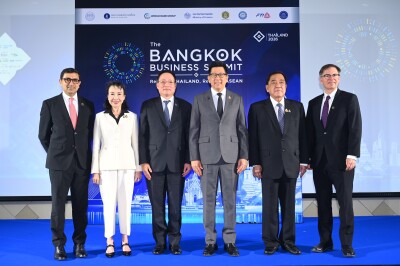
Deputy Prime Minister Ekniti Nitithanprapas outlined an investment-led blueprint anchored by an upgraded Joint Public Private Committee (JPCC), private-sector syndication, and World Bank alignment ahead of the 2026 Annual Meetings and 2028 ASEAN Chairmanship.
BANGKOK, THAILAND – Media OutReach Newswire – 7 September 2026 – Thailand is ready to cross into “new horizons” — achieving high-income status and driving a more resilient ASEAN, declared Deputy Prime Minister and Minister of Finance Dr. Ekniti Nitithanprapas as he delivered the closing address at the Bangkok Business Summit 2026 today,

Detailing the strategic “why, how, and design” of the national transition, Dr. Ekniti stated that entering new horizons is an unavoidable global imperative. While ASEAN is uniquely positioned to capture emerging opportunities, the region must guard against severe geopolitical, technological, and climate risks with proactive, unified action.

“The goals must be clear, and we are completely on the same page: Thailand must achieve high-income status,” said Dr. Ekniti.
“The recipe provided by the World Bank aligns directly with what our business leaders have outlined. An investment-led growth policy, private-sector-centred endeavours, and persistent implementation are what the government and business community are now executing together. Think of the seven new growth engines as our forwards on the pitch. The government acts as both coach and midfielder — spearheading investment, driving trade, empowering SMEs, unlocking regulatory friction, and cultivating human capital. Meanwhile, fiscal and financial stability serves as our steadfast defensive backline.”
Dr. Ekniti affirmed that the Joint Public and Private Committee (JPPC) will no longer function as a purely advisory body, but will operate as an executive economic steering council mandated to enact structural reforms and track execution against the World Bank’s recommendations.
“We will not be the same old Thailand. We will be driving the global agenda. Thailand will enter new horizons, empower people, and build resilience,” Dr. Ekniti emphasised. “In the next two years, Thailand will assume the Chairmanship of ASEAN. We will establish a long-term, multi-year agenda for a stronger, more resilient ASEAN. If this new model of public-private partnership carries on, we will decisively reinvent Thailand.”
Key leaders representing the Joint Standing Committee on Commerce, Industry, and Banking (JSCCIB) delivered strategic sector priorities to anchor the transition.

Payong Srivanich, Chairman of the JSCCIB and the Thai Bankers’ Association, underscored that reinventing the economy requires modernising legacy industries while creating space for future engines.
“From three core challenges – structural, competitiveness, and public-sector efficiency – came the White Paper outlining the seven industries of the future,” stated Mr. Payong. “This time, the government has presented a credible policy framework based on collaborative public-private partnership. Thailand must address fundamental security—whether in food, energy, or low-carbon growth. We are declaring to the world that we are done with planning and on the same page. Now we are geared up for execution.”
Dr. Poj Aramwattananont, Chairman of the Thai Chamber of Commerce and Board of Trade of Thailand, stressed that amid geopolitical friction, geoeconomics, and regional conflict, growth must be anchored in ASEAN’s 600-plus million people which serve as both supply and demand networks.
Adapting to international trading rules is inseparable from Thailand’s targeted accession to the OECD by 2028. The accession process acts as the structural catalyst to modernise domestic legislation, corporate governance, transparency, and fair market competition to premier global standards—lowering compliance costs and solidifying investor confidence.
Pimjai Leeissaranukul, Chairwoman of the Federation of Thai Industries, insisted that Thailand must build its own brand; it can no longer afford to be just the world’s OEM. She called for a decisive departure from labor-cost competition toward high productivity, automation, AI, and green sustainability. She advocated expanding target sectors—such as next-generation electric vehicles, smart electronics, automation, and wellness—while enforcing enhanced public procurement.
Carlos Felipe Jaramillo, Vice President for East Asia and Pacific at the World Bank, observed that the eyes of the financial world will be on Bangkok next month as it hosts the 2026 IMF–World Bank Group Annual Meetings, providing Thailand with a premier global stage to show that it is advancing on a credible pathway to attain high-income status by 2037.
“The World Bank has presented a series of structural reforms that Thailand can pursue to reach high-income status, creating more and better-paying jobs for young Thais in the future,” Mr. Jaramillo stated. “The plan deliberately puts the private sector at the center, because experience has taught us that the private sector is the primary engine of employment. This reform agenda is multifaceted, requiring coordinated national effort, and, more importantly, relentless persistence in implementation.”
The Bangkok Business Summit 2026 concluded with a clear consensus: today’s closing discussions mark the formal launch of sustained, institutionalised execution across the public sector, private enterprise, and multilateral institutions to ensure Thailand stands as a resilient economic anchor for the wider ASEAN region.
Hashtag: #JSCCIB
The issuer is solely responsible for the content of this announcement.