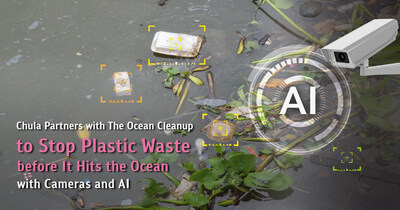
Bangkok,, September 22, 2025 / Prnewswire / – Chulalongkorn University Associated with the cleaning of the ocean and the department of marine and coastal resources to use the technology of cameras and the AI to analyze the quantity of waste in the Chao Phraya river, aimed at reducing environmental impacts and promoting effective policies of waste management on land and water sources.
If you think the waste you throw today will disappear from your life forever, think again!
“By examining the label of plastic waste found on the Chao Phraya river, we found garbage that goes up 10 years!” Professor Dr. SUCHANA CHAVANICH, professor of marine sciences, Faculty of Sciences and assistant director of the Aquatic Resources Research Institute, Chulalongkorn UniversityRevealed the results of the plastic waste elimination project from the Chao Phraya river BangkokWhere Chula researchers used cameras and AI technology to intercept and follow waste in the Chao Phraya river from 2021 to 2024.
“Currently, Thailand ranks in the top 10 of the world for ineffective waste managementresulting in high levels of marine pollution, “said Professor Dr.suchana.
In the past, many organizations and sectors have continuously tried to raise awareness and promulgate policies and measures to reduce and eliminate waste on earth and sailors to reduce marine waste. Likewise, the last pilot project – research has focused on eliminating plastic waste from the Chao Phraya river Bangkok“A collaboration between Chulalongkorn University, The Embassy of The NetherlandsTHE Marine and coastal resources department,, Bangkok Metropolitan Administration (BMA)and the private sector under the operation of Ocean cleaninga non -profit environmental engineering organization of The Netherlands which aims to study the quantity of waste in the five oceans of the world. The project team is made up of scientists, engineers, designers and volunteers working together to develop technologies to tackle the problem of marine waste.
Waste problem in Thai rivers and seas
Based on the data on the quantity of municipal management of solid waste and waste management in 23 coastal provinces in 2022, the Marine and Coastal Resources Department estimates that the quantity of marine waste at 11.60 million tonnes. Of this amount, 302,389 tonnes (or 0.30 million tonnes) are “plastic waste” and 10 to 15% of this plastic waste can stay on the beach or float in the sea and become “marine waste”, totaling approximately 30,239-45 358 tonnes or 0.03-0.45 million tonnes.
The Department of Marine and Coastal Resources (DMCR) has actively implemented various marine waste management initiatives since the 2017 financial year, aimed at raising awareness and considerably reducing waste in the ocean and along the coastline. The project also seeks to prevent the re -emergence of marine waste by cleaning the remaining waste Thailand Critical ecosystems – including beaches, coral reefs and mangroves forests – across 21 coastal provinces. The initiative operates through collaborative networks involving local communities, municipal organizations, government agencies, private sector and others. Despite these serious efforts, plastic and general waste continue to pollute Thailand Navigable and seas waterways. If it is left untreated, contamination of waste in water sources could constitute serious threats to marine life, public health and the national economy, in particular in the fishing and tourism sectors, while tarnishing Thailand Long -term international image.
Cameras and AI detect the quantity and path of waste in rivers
Professor Dr. SUHANA said that in the Research project on the elimination of plastic waste in the Chao Phraya river BangkokA team of researchers from Chula was responsible for studying and collecting data on the quantity of waste in the Chao Phraya river from 2021 to 2024 to analyze the quantity of waste flowing in the sea and the study of the efficiency of automated waste and solar energy (interceptor) in the reduction of waste before reaching the ocean. “The Chula search team has installed detection cameras for three major bridges: Pont King Pinklao, Choice of staffand Bhumibol bridge, where garbage flows downstream. These cameras record images every 15 minutes so that the amount of waste can be followed 24 hours a day with more efficiency than observing it with the naked eye. “Professor Dr. Suchana explains the waste collection and analysis process.
“Then, the ocean cleaning AI will help process photos, analyze the quantity and type of waste that pass under the bridges, follow the path of waste movement and assess the efficiency of the interceptor.”
Research results and future orientation
Professor Dr. SUchana revealed preliminary results that “plastic waste“is always the main waste found in the Chao Phraya river, and the use of the interceptor of solar energy waste considerably reduces the quantity of waste flowing in the sea. The interceptor can collect up to 6 to 7 tonnes of waste over 2 to 3 days, depending on time.
Initially, the data collected and analyzed using the AI will be used to guide the formulation of policies by the Department of Marine and Coastal Resources and relevant organizations, which aims to continue the project for three years. Professor Dr. SUCHANA expressed his confidence that the research team has completed data analysis, the results will lead to more effective waste management strategies.
“The results of this study will serve as a” crucial database “which can be developed in a more efficient and systematic river waste management plan. This will allow us to develop more precise and sustainable waste management policies at local and national levels – for example, the identification of large DUMP zones to plan preventive measures, the development of policies or regulations to reduce waste waste in navigable channels and promote community management of waste at source. All of these efforts will help reduce long -term environmental impacts, “said Professor Dr. Suchana. She has also added:” The use of imaging technology and AI will help us understand the areas that still require waste management, that waste interceptors are in place. It also allows us to assess the effectiveness of existing public and private waste management initiatives. “”
In the end, the waste crisis has no borders – collective consciousness and action in all sectors are essential.
“The resolution of the waste problem is a shared responsibility. This international cooperation highlights the fact that the waste that we suppose to be the problem of our country can be swept away in the sea and affect other nations. Consequently, waste management is not only a national problem – it is a global challenge that all countries must take up together,” concluded the teacher. Dr. SUHANA.
Read the full article at: https://www.chula.ac.th/en/highlight/246496/
About Chulalongkorn University
Chulalongkorn University has established the list of the best universities in the world for employment results, which reflects both the high employment rate and the work capacity of Chula graduates. The university is also listed as the best of Thailand For the 15th consecutive year (since 2009), according to the new classification of the World University QS 2024, putting Chula to the 211st in the world, up 2444th last year.
Social networks:
Facebook: https://www.facebook.com/chulalongkorniniViversity
Youtube: https://www.youtube.com/chulauniversity
Linkedin: https://www.linkedin.com/school/15101896/
 Show original content to download the multimedia:https://www.prnewswire.com/apac/news-releases/chula-partners-with-ocean-cleanup-coplastic-waste-before-it-hits-terhe-ocean-with-caméras-et-302556537.html
SOURCE Chulalongkorn University