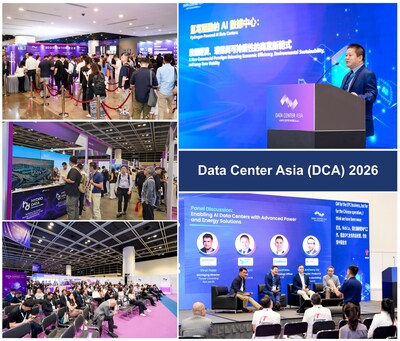
SHENZHEN, China, January 16, 2025 /PRNewswire/ — Recently, Huawei held a conference on the top ten data center installation trends for 2025. At the conference, Yao QuanPresident of Data Center Facilities Domain, explained the top ten trends with the aim of injecting new impetus into the development of the data center (DC) industry in the AI era, gaining insight into the transformation and lead the rapid development of the sector. .

As Yao Quan stated, DCs have evolved from general-purpose computing power to intelligent computing power thanks to continued innovations in AI core model technologies. Server performance and power have been significantly improved and building clusters with 1000 GPUs, 10000 GPUs and 100000 GPUs has become the norm. The DC industry enjoys unprecedented development opportunities and also faces challenges in reliability, high power, high electricity demand and uncertainty.
Based on in-depth insights and long-term practices, Huawei released the top ten trends of Data Center Facility 2025, focusing on reliability, flexibility and sustainable development. It is about sharing ideas and thoughts on AI DC facilities, creating a highly reliable computing foundation and pushing the digital age forward.
Trend 1: Reliability Becomes the Top Fundamental Requirement for Intelligent IT Domain Controllers
Safety is the top priority of DC construction over cost. In particular, the value of AI devices is increasing and the scope of the fault domain continues to expand in the era of intelligent computing, making reliability the main fundamental requirement of intelligent computing DCs. DC reliability is essentially reliability throughout the life cycle, covering components, products, architecture, services and O&M. Unreliable DC power will result in higher operating cost. To achieve truly low costs, reliability must be guaranteed.
Trend 2: Isolated architecture is the best choice to ensure the reliability of intelligent IT installations
The power density of intelligent computing centers continues to increase. Electrical equipment is generally characterized by high voltage and large current, and it is essential to ensure its safe and reliable operation. Remote deployment of DC electrical equipment is preferable to ensure stable operation of the service. Additionally, electrical equipment, if deployed in the main technical room, must be isolated from main services and deployed in a standard manner. Fire resistance duration, water fire extinguishing, emergency ventilation and one-click power-off requirements should be considered to minimize service impacts.
Trend 3: Uninterrupted cooling is the mandatory capability for high-density intelligent computing
In the AI era, air-liquid coexistence is a long-term process. Liquid cooling is an inevitable trend, and uninterrupted cooling will become a mandatory capability for high-density intelligent computing. Uninterrupted cooling means no cooling interruption when the DC is operating properly and rapid cooling recovery in case of exceptions. By doing so, DCs can operate stably.
Trend 4: AI will significantly improve proactive security in data center operations and maintenance
With AI technologies, faults such as power outages, fires and high temperatures in DCs can be precisely avoided. This facilitates the transition from passive response to active maintenance and allows us to identify potential risks in advance, thereby significantly improving DC reliability.
Trend 5: Professional services provide a strong guarantee for reliable distribution center operation
A DC typically has a lifespan of 10 to 15 years and maintenance is a more determining factor than equipment in the entire life cycle of the DC. Professional services are the key to long-term, reliable operation of the DC. No potential risks are left during deployment thanks to professional deployment and complete management of the DC delivery process. Additionally, AI technologies are being introduced to implement predictive maintenance instead of fault response, thereby ensuring DC reliability throughout the life cycle.
Trend 6: Modular architecture is the key to addressing the uncertainty of AI DC requirements
A modular architecture is necessary for AI DCs to flexibly respond to the uncertainty of AI DC requirements. A modular architecture includes standardized equipment rooms, modular functions and decoupled electromechanical devices, which can ensure on-demand deployment and elastic scaling of core subsystems as well as flexible adaptability to future development of services. Take the Wuhu DC China as an example. Adopting modular architecture, the DC is delivered within three months and supports elastic scaling in the future.
Trend 7: Subsystem prefabrication is an effective method for rapid delivery of AI DC
Prefabrication offers greater production efficiency. DCs that host prefabricated subsystems can better meet the requirements of AI services in terms of elasticity and rapid deployment. The prefabrication of subsystems is not a simple assembly but a production of solutions. It must go through professional design, simulation, testing and automatic tooling to ensure the quality of product delivery. In addition, the on-site construction workload is reduced by 90% through factory prefabrication and pre-commissioning, which significantly shortens the delivery time and ensures high-quality and timely delivery of DCs. AI.
Trend 8: High power supply efficiency is increasingly valuable in AI DCs
High-density and supercomputing scenarios pose difficult heat dissipation challenges. From air cooling to liquid cooling, power efficiency is becoming a major factor in energy efficiency. To examine the power supply efficiency of DCs, the focus should be on the power supply efficiency of the parallel system rather than that of a single device and architectural innovation. For example, the inverter can have a high efficiency of 99.1% and implement 0 ms switching between modes when operating in Super Economy Control (S-ECO) operating mode.
Trend 9: AI helps improve overall energy efficiency in developing countries
In addition to improving power and cooling efficiency, AI technologies can further help enable the link between layers 1 and 2. There are millions of optimization parameters in the cooling scenario air-liquid, exponentially complicating optimization. To achieve optimal cooling effect, AI energy efficiency optimization technology can be used to replace traditional manual optimization. The application of AI technologies makes DCs more energy efficient and energy efficient.
Trend 10: IT-electricity collaboration will become a new mode of DC construction
Computing power is key to AI, and electricity is essential to computing power. As the energy consumption of DCs continues to increase, direct sourcing of green energy will be a solution to reduce the energy consumption of DCs. In addition, as a load link for power generation-grid-charging-storage integration, DCs can be connected to the power grid to improve grid utilization efficiency (GUE) through power regulation. frequency and peak shaving. Domain controllers can flexibly schedule loads based on AI training and inference requirements to achieve optimal overall efficiency. In the future, the synergy between information technology and energy will constitute a new mode of construction of developing countries, thereby stimulating the sustainable development of developing countries.
In the AI era, Huawei Data Center Facility will focus on quality and technological innovation to create a highly reliable, flexible and durable power supply solution for intelligent data centers, helping customers and partners grasp intelligent computing opportunities and maximize the output of every watt. in an effort to advance the digital age.
 View original content to download multimedia:https://www.prnewswire.com/apac/news-releases/powering-the-digital-era-forward–huawei-releases-top-ten-trends-of-data-center-facility-2025-302352984.html
SOURCE Huawei Digital Power