

Leveraging Hong Kong’s Leading Four-Stage Value Chain in Asia to Capture Significant Market Opportunities
- Responding to Global Energy Transition Demands: Energy security, renewable energy grid integration, accelerating electrification, and surging power demand from AI infrastructure are jointly propelling the growth of the battery and energy storage (BES) industry.
- Demonstrating Hong Kong’s Comprehensive Industrial Ecosystem: Boasting a comprehensive four-stage BES value chain, Hong Kong ranks among Asia’s premier energy storage ecosystems, driving circular industry development. Three of the world’s top ten energy storage giants—CATL, BYD, and Gotion High-Tech—have established a presence within HKSTP’s ecosystem
HONG KONG SAR – Media OutReach Newswire – 29 October 2026 – Facing global energy security challenges, accelerating electrification, and massive power demands driven by artificial intelligence (AI) data centers, Battery and Energy Storage (BES) has emerged as a key driver of the low-carbon energy transition. Hong Kong Science and Technology Parks Corporation (HKSTP) today officially released its inaugural BES Strategic Analysis Report at the international flagship event One Earth Summit 2026.

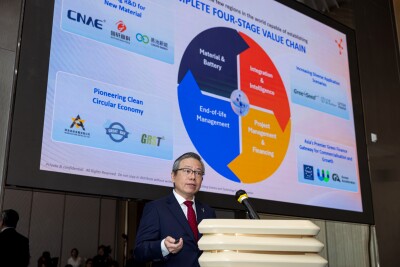
Mr Terry Wong, Chief Executive Officer of HKSTP, delivered a keynote address titled “Supercharging Battery and Energy Storage Innovation for Energy Transition” at the Summit, to share insights from the report and experiences in commercialising home-grown R&D. The report highlights the explosive growth of the global BES market while underscoring Hong Kong’s position as Asia’s leading Greentech hub, driven by a comprehensive four-stage value chain spanning frontier R&D, integration and intelligence, green finance, and end-of-life battery management.
Mr Terry Wong, Chief Executive Officer of HKSTP, said: “HKSTP is fully committed to supporting the nation’s 15th Five-Year Plan, Hong Kong’s first Five-Year Plan, and the HKSAR Government’s Policy Address initiatives, as we work tirelessly to build Hong Kong into an international innovation and technology hub. The global energy transition is ushering in an unprecedented golden era for the BES industry. By taking the initiative to publish our inaugural Strategic Analysis Report, HKSTP is not only identifying global industry opportunities, but also showcasing Hong Kong’s position as a leading energy storage ecosystem in Asia with a comprehensive value chain. HKSTP will continue to serve as both a ‘super-connector’ and a ‘super value-adder’, helping companies overcome commercialisation barriers, align with international standards, and capture the significant opportunities in the global multi-trillion-dollar energy storage market.”
HKSTP regards green technology as one of its core strategic industries. Its ecosystem brings together more than 250 green tech companies, around 100 of which focus on BES. In response to the strong growth driven by the global energy transition, HKSTP aims to increase the number of BES companies by 60% to more than 160 over the next few years. Notably, three of the world’s top ten battery and energy storage leaders—CATL, BYD, and Gotion High-Tech—have already established a presence within the HKSTP ecosystem. Their presence creates strong industrial synergies with park companies, deepening cross-disciplinary technology exchanges, supply chain integration, and business matching.
Two Key Insights Outlining Opportunities for Hong Kong’s Energy Storage Industry:
The report provides an in-depth analysis of market data and compares BES development models and policies across major global economies. Drawing on interviews with local and overseas industry partners and park companies, it identifies two key insights:
As the world confronts a global energy transition, nearly 200 countries have pledged to expand renewable energy and phase down fossil fuel reliance, aiming to boost electricity’s share of global final energy demand from approximately 20% today to 35% by 2035. Concurrently, the rapid rise of AI is driving an unprecedented surge in data center power demand. Global electricity consumption from computing infrastructure is projected to more than double, rising from 415 terawatt-hours (TWh) in 2024 to 945 TWh by 2030. Battery and energy storage technologies are becoming increasingly critical, with related industry investment expected to reach USD 5 trillion—equivalent to nearly HKD 40 trillion—over the next decade.
Mainland BES companies currently account for more than half of the global battery applications market. Leveraging its unique advantage of being backed by the Chinese Mainland while connected to the world, Hong Kong has become a preferred springboard for Mainland energy leaders expanding overseas. As European and US markets impose increasingly stringent trade and compliance requirements on new energy supply chains, Mainland companies can draw on Hong Kong’s mature common law system, international certification standards, and leading green finance platform in Asia-Pacific to meet international compliance requirements and expand their global presence.
Hong Kong’s BES development is supported by a four-stage value chain covering “Material and Battery”, “Integration and Intelligence”, “Project Management and Finance”, and “End-of-Life Battery Management”, enabling sustainable development and a green circular economy.
- Material and Battery: Hong Kong is home to five of the world’s top 100 universities and possesses world-class research capabilities. Its leading university network and open talent admission schemes have successfully attracted international talent. Several HKSTP park companies focus on cutting-edge R&D in next-generation batteries. For example, Luquos Energy, led by a team from The Chinese University of Hong Kong, has successfully developed the world’s first sulphur-based flow battery. Technology significantly reduces costs while avoiding the fire risks associated with overheating in conventional lithium-ion batteries, enhancing safety.
- Integration and Intelligence: Assembling batteries into battery packs or containerised energy storage systems enables wider deployment across communities. Hong Kong’s exceptionally high-density urban environment offers abundant real-world application scenarios for energy storage technologies. The growing number of electric vehicles is driving demand for fast-charging infrastructure. With more than 60% of private buildings in Hong Kong over 30 years old and facing power supply capacity constraints, energy storage systems can store electricity during off-peak periods and discharge it during peak periods, providing a supplementary solution for ageing buildings. Park companies’ technologies are also being deployed at construction sites to support the high-power demands of heavy machinery and reduce reliance on conventional diesel generators. Meanwhile, intelligent technologies are steadily maturing, including the use of AI to monitor battery condition and health.
- Project Management and Finance: A range of large-scale projects in Hong Kong supports BES development, including a major local battery energy storage system under construction by a power company. The commercial sector is also accelerating the adoption of energy storage technologies. Park company Halo Energy, for example, has partnered with XPENG to introduce the world’s first megawatt-level ultra-fast EV charging station in Hong Kong, setting a new benchmark for smart mobility in the city. As Asia’s largest international green and sustainable debt arranging hub, Hong Kong also plays a distinctive role as a green finance gateway, with related issuance exceeding USD 76 billion in 2025. This month, HKSTP also signed a memorandum of understanding with the “Green Accelerator” to connect promising green tech companies with capital and financing channels, helping startups progress from R&D to commercialisation.
- End-of-Life Battery Management: Market projections indicate that Hong Kong will generate nearly 6,700 tonnes of retired EV batteries in 2030, making proper treatment and the reduction of environmental pollution pressing priorities. Several park companies have already taken the lead in technology development. GRST, for example, has developed a non-toxic, water-soluble battery binder that eliminates the need for conventional incineration or strong-acid soaking during battery recycling, reducing carbon emissions at the recycling stage by up to 80%. Together with the HKSAR Government’s introduction of the city’s first large-scale EV battery recycling facility last year, which converts waste batteries into valuable mineral resources, these efforts demonstrate how industry, government, and the research community are working together to build a green circular economy.
HKSTP is committed to capturing the global energy transition opportunities identified in the BES Strategic Analysis Report and developing Hong Kong into an international green technology hub. HKSTP’s GreenTech Hub in Kowloon Tong will continue to serve as a bridge, deepening cross-sector collaboration among companies, research institutions, and industry partners. It will help investors identify energy storage opportunities, advance the adoption of cutting-edge green solutions, and accelerate startup commercialisation, building a green innovation ecosystem with international influence and jointly tapping into the global market for the green energy transition.
HKSTP also showcased green solutions from six park companies at the summit, fostering exchanges among tech ventures, industry partners, and investors.
Exhibiting Park Companies:
- Luquos Energy Limited
- Syneric Technology (HK) Limited
- CAS Testing Technical Services (Hong Kong) Company Limited
- Nanofil Filtration Technology Limited
- ECO Technologies Limited
- i2Cool Limited
Hashtag: #HKSTP
The issuer is solely responsible for the content of this announcement.
Hong Kong Science and Technology Parks Corporation
Hong Kong Science and Technology Parks Corporation (HKSTP) was established in 2001 and has built a proven foundation as Hong Kong’s leading innovation and technology (I&T) ecosystem. Established for 25 years, HKSTP is supporting 14 unicorns, has nurtured more than 17,000 research professionals and built a community of over 2,500 technology companies from 26 countries and regions across four strategic technology clusters: Life and Health Technology, AI and Data Science, Microelectronics and Advanced Manufacturing, and GreenTech and New Energy.
As an ecosystem orchestrator, HKSTP provides end-to-end support to attract and nurture talent, accelerate commercialisation and help technology ventures scale. Its innovation infrastructure spans over 240 hectares covering Hong Kong Science Park in Pak Shek Kok, InnoCentre in Kowloon Tong, and three modern InnoParks in Tai Po, Tseung Kwan O and Yuen Long, advancing Hong Kong’s vision for new industrialisation and smart manufacturing.
Hong Kong Science Park Shenzhen Branch in Futian, Shenzhen, strengthens cross-border collaboration by connecting Hong Kong, the Chinese Mainland and global innovation networks and propels Chinese innovators onto the world stage, while also delivering comprehensive GBA landing support to accelerate cross-border success for local and international ventures.
As HKSTP enters its next chapter with strong foundations, it continues to deepen impact, elevate quality and create value for innovators. As an ecosystem built to lead change, HKSTP is empowering Hong Kong to define what comes next in innovation, growth and opportunity.
More information about HKSTP is available at  www.hkstp.org.